The End of Net Zero and the Revival of British industry Conference
 CIBUK.org
Posted On December 9, 2025
CIBUK.org
Posted On December 9, 2025
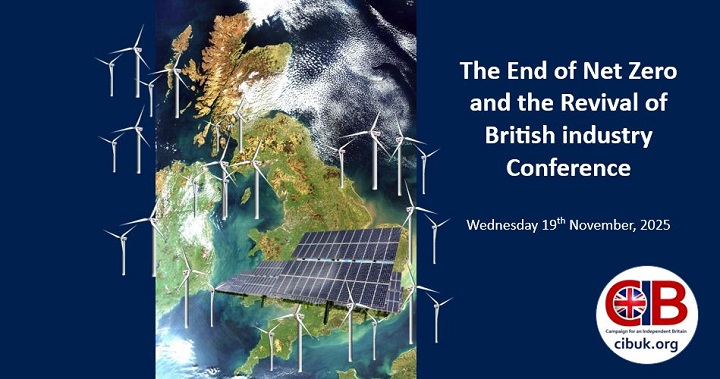


The End of Net Zero and the Revival of British industry Conference
Wednesday 19th November, 2025
Introduction
Your correspondent was delighted to attend the above conference courtesy of the Prosperity Institute on Charles Street, just a stone’s throw from Berkeley Square.
The all-day event began with an introduction by PI’s Director of Strategy Fred de Fossard who provided the background context to the conference, outlining the appalling effects which net zero is having on our industrial infrastructure as well as our capacity to keep the lights on and our homes heated.
Decline has been decades in the making he said in a withering attack on both the Labour and Conservative parties which have sought to outdo one another in their rush to net zero irrespective of the practical cost to the country as a whole.
What follows are summary highlights arising from the Conference.
The future of British energy policy
Opening the day’s discussion on behalf of the panellists was Richard Tice MP, Deputy Leader of Reform UK who mounted a withering assessment of the government’s dash to ‘net-stupid-zero.’
Oil refineries under threat
The decision to issue a ban on production licences for oil and gas has had a devastating effect on refineries across the United Kingdom, resulting in the imminent closure of the Mossmorran Natural Gas Liquids (NGL) plant in Fife early next year.
The Prax Lindsey Oil Refinery in North Lincolnshire is another refinery whose future remains in doubt, with a possible loss of over 4,000 jobs.
‘Whole communities are being destroyed’
It is not just the refineries business which is being sacrificed. Without access to cheap and plentiful sources of energy the implications for British industry as a whole are extremely serious.
It is possible, he said, that 50% of the UK car industry could go in the next few years. The decision to cover Lincolnshire’s fields with solar panels leaves the land beneath inorganic after 20 years, thereby destroying our capacity to produce food and pushing up prices in the process.
‘Scrap Emissions Trading Scheme’
A future Reform UK government would scrap vast swathes of legislation including ETS and in Scotland they are campaigning on a commitment to ‘drill, baby, drill’. The message seems to have gone down very well and their poll ratings are rising as a result.
National Security
There is also a geo-strategic imperative for continuing to produce our own energy. Oil and gas refineries are part of our national security. At present the UK is currently importing vast quantities from overseas, adding to CO2 emissions and making other countries rich whilst impoverishing ourselves. In addition, we are vulnerable to supply-chain shocks similar to those which occurred after Russia’s invasion of Ukraine.
If we want access to cheap and plentiful energy to power our economy it lies beneath our feet and around our shores, ready and waiting to be drilled and tapped.
Energy and Artificial Intelligence
There is much talk of promoting the UK as a global AI hub. But as everyone knows, AI data centres require enormous amounts of energy to power them. The UK will not be in a position to take advantage of these new opportunities without cheap, abundant energy and as things currently stand it is simply not viable to host these hubs here in Britain.
‘This cannot go on: time for a Net Zero reality check’
What followed was an insider’s perspective on the reality of energy production in the UK, led by Rich Walsh, Executive Vice President of Valero Energy Corporation – an American-based fuels producer with refineri s across South Wales employing 5,000 people.
‘In the end you need a return on capital. A lot of money is going out the door without a lot of return.’
He underlined the point made earlier by Richard Tice that successful refineries require access to cheap electricity. Currently the UK has some of the most expensive electricity in the developed world leading to a devastating impact on jobs and investment in the industry. We once had nineteen refineries in United Kingdom. Now we are down to four.
Those are just the headline losses. Equally serious are the many ancillary industries which depend on refined oil for their survival including chemical production, plastics, agricultural fertilisers, pipelines and logistics.
Rich Walsh also emphasised how many really good, well-paid apprentice-level jobs there were in the sector including mechanics, electricians, fitters, welders, builders and contractors of all kinds. The rush to net-zero puts these well-paid jobs at risk and is never even discussed or reported in the media.
This point was amplified by Georgiana Bristol of the Jobs Foundation who said there were thousands still employed in the oil and gas sector and only a few hundred in renewables.
‘Saving the Planet is a popular cause of MPs because it is exciting and gets people’s attention.’
Graham Stringer MP provided us with an insider’s view on the government’s attitude towards net zero which borders on devotion. He remains highly critical of the present policy, pointing out the paradox of wind turbine manufacturing which is a highly toxic process requiring the mining of rare earths at huge environmental cost coupled with the export of these giant windmills half-way across the world to be installed over here.
What does clean energy mean? CO2 is not poisonous.’
He said that a collision with reality is imminent and is heartened by Tony Blair’s intervention in the debate. The former Prime Minister recently stated that current net-zero policies based on limiting short-term consumption and phasing out fossil fuels are “doomed to fail” because they lack public support and are not working effectively.
In conversation with Claire Coutinho MP, Shadow Secretary of State for Energy Security and Net Zero
‘Is there public support for net zero? They don’t know what it is!’
We were given an insight into current Conservative Party thinking on the environment by its Shadow Secretary of State for Energy, Claire Coutinho. The unbridled enthusiasm for all things green under Boris Johnson has been replaced by something altogether more pragmatic.
Not one to mince her words, Ms Coutinho said a great deal of ‘BS’ had been spouted about environmental policy and politicians had failed to be honest with the public about the very painful trade-offs that were required in managing the transition from a carbon economy to a renewable one.
Her overriding priority was to provide as much cheap energy as possible and if that meant using a multitude of sources including oil and gas to do so then so be it.
‘Planting trees does not reduce people’s bills’
She said there was a huge amount of disinformation in the public sphere being peddled by people who don’t know what they are talking about including civil servants and leading politicians. The result is an ill-informed debate in which the public are being misled.
A future Conservative government would re-issue drilling licences in the North Sea for oil and gas. They would also roll out an expansion of small and medium-size nuclear reactors (SMRs and MMRs).
Not only does nuclear energy provide abundant clean energy, but the land density of nuclear is far smaller than renewables, where thousands of acres are required to install solar panels and wind turbines.
‘COP is a climate-change Glastonbury’
She concluded with a withering assessment of the annual climate change gatherings so beloved of the international political class. These conventions are not working and are merely a discussion forum for countries to pay lip-service to the need to address Climate Change. Meanwhile China and India continue building coal-powered fire stations every week to power their own economies.
The event was brought to a close with a drinks reception at the end of the day and a guest appearance by Shadow Business Secretary Andrew Griffiths MP who provided the assembled company with a tour-de-force extolling the virtues of low tax, low regulation, the entrepreneurial spirit and an energy policy designed to support economic growth rather than hinder it.
On behalf of us all at CIBUK.Org, we would like to thank the Prosperity Institute for their hospitality in hosting the above event.